

You Cannot Reject the Rain
Noah’s Ark and the Christian Duty to Prepare for the World After AI

I. The Rain Does Not Need Your Consent
The AI revolution is the modern flood.
That does not mean AI is evil in itself. Rain is not evil. Water gives life, cleanses the ground, fills the river, and feeds the field. Then it rises too high, and the same water that nourished the garden carries away the house.
AI has entered the world in that manner. At first it appears as a tool. A helper. A clever machine that writes emails, drafts code, makes images, answers questions, sorts files, and rescues office workers from the sacred horror of formatting tables. Small mercy. Even Pharaoh might have liked a spreadsheet assistant.
Then the waterline moves.
Work changes. Art changes. Education changes. Status changes. Childhood changes. Bureaucracy changes. The old bargains begin to rot under the floorboards.
Noah was not asked whether he preferred dry weather.
Modern man talks about technology as though he can accept or reject it from the comfort of a chair. He says he will opt out. He says he will go offline. He says he will stay authentic. Then he uses GPS to reach the farmers market, pays with a phone, and posts about simplicity beside a latte that required six continents to appear in his hand.
The Christian task is not to mistake refusal for holiness. A confused demonology of machines gives man the pleasure of denunciation without the burden of construction. That is a pleasant little shed to die in.
The flood does not need a vote.
Our choice is preparation or ruin.
The rain is already practicing its handwriting.
This is why the question of trying in the age of AI matters. The machine can generate mountains of content, but man must still decide what is worth saving. Kingsnorth warns that AI threatens the human space where stories are received, formed, and given back by living souls (Kingsnorth, 2026).
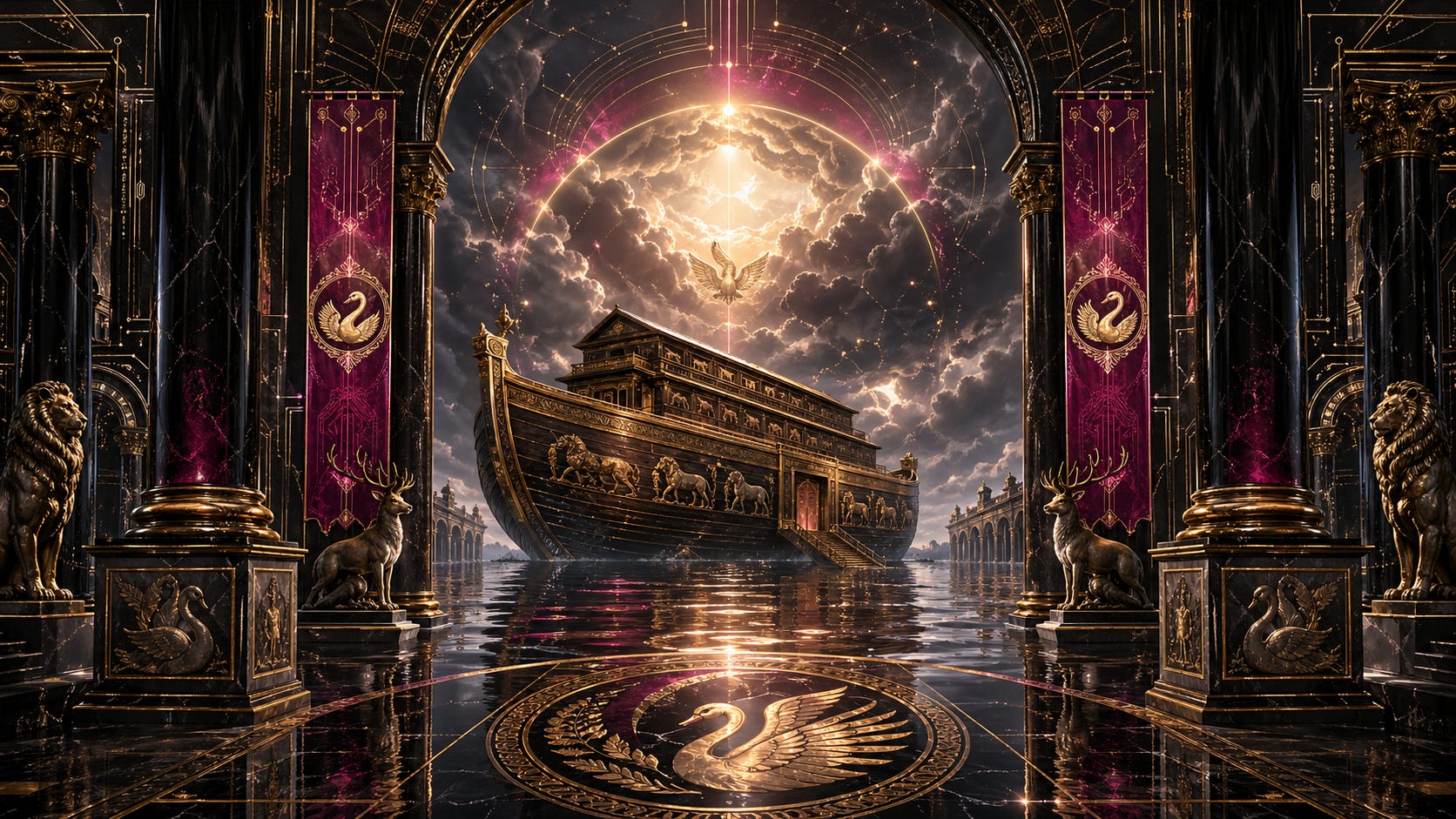
II. Noah Was Not a Reactionary
Noah did not preserve the old world by refusing the flood.
He preserved life by preparing for the world after it.
That distinction matters because Christians often confuse faithfulness with refusal. They see a new force entering history and assume the righteous answer must be negation. Sometimes it is. Many modern things deserve to be thrown out with tongs, sealed in a barrel, and assigned to a raccoon tribunal. Yet AI is not one vice among many. It is a civilizational condition.
A man may reject pornography. He may reject consumerism. He may reject political hysteria, cheap entertainment, and the glazed cult of convenience. He cannot reject a transformed economy any more than Noah could reject rainfall by issuing a stern family statement.
The ark was an act of obedience under altered conditions.
It was construction.
Noah built something that could carry the living through judgment. He gathered what had to survive. He accepted that the ground beneath him would vanish and acted before the water rose. This is why the ark is the proper Christian image for the AI age. It is neither surrender nor panic. It is disciplined preparation.
The old world was condemned.
Life still had to continue.
The Christian imagination must recover this pattern. Scripture is not a flat instruction manual for private sincerity. It is the grand drama of creation, fall, covenant, judgment, and renewal. That frame is large enough to understand technological rupture without hiding under the bed like a damp pamphlet.
This is the proper use of biblical pattern: not prediction games, not evangelical weather charts, but a disciplined recognition of divine judgment and renewal. Kingsnorth’s campaign of refusal has force because it defends human making against the machine, but refusal alone cannot rebuild a world after the waters recede (Kingsnorth, 2026).
III. The Old Ground Is Going Underwater
AI will first punish those who mistook procedure for wisdom.
This is why the respectable classes are nervous. They know, somewhere beneath the laminated conference badge of the soul, that much of their status rests on controlled access to language. They write. They summarize. They advise. They assess. They generate memos with the gravity of medieval scribes and the spiritual depth of an airport sandwich.
AI is coming for that world with a calm face.
It can draft the memo. It can summarize the meeting. It can write the policy brief. It can produce the marketing plan. It can make the slide deck. It can imitate the tone of the salaried class so well that the salaried class has begun to notice the joke. The machine has learned their dialect, and the dialect was most of the outfit.
This does not mean all white-collar work disappears. It means the costume loses power.
Credentials will still matter where trust, law, and responsibility remain attached to real persons. Skill will still matter where reality pushes back. Surgery, engineering, command, pastoral care, serious teaching, craftsmanship, and leadership will not be dissolved by a chatbot with neat margins.
Yet the false middle will suffer.
The people who know how to sound competent without being competent will find themselves in a crowded room with a machine that does the same thing faster, cheaper, and without asking for remote Fridays.
The flood exposes foundations.
That is why the slow hollowing of work matters more than the theatrical panic. The task disappears first. Then the responsibility. Then the social status that once sat on top of both like a decorative pigeon. Kurtz describes this rupture as a threat to the middle of the labor market, where AI and economic disruption produce a growing class with fewer secure roles inside the old order (Kurtz, 2026).
A civilization that cannot give its displaced men work, honor, and membership will eventually receive from them something less charming.
History has many departments. The complaint office is usually on fire.
IV. The Ark Is a Structure of Life
The ark is not an escape pod.
It is a portable civilization.
That is the point modern Christians must grasp. Preparing for AI does not mean hiding in a cabin and muttering about the old days while the children secretly learn more from a tablet than from their father. It means building structures of life strong enough to pass through technological upheaval without losing the human person.
The modern ark begins with the household.
A home must become more than a place where tired people sleep beside glowing rectangles. It must recover discipline, prayer, meals, songs, books, work, hospitality, and command. The father cannot outsource formation to a screen and then complain that his children were catechized by strangers. The mother cannot be asked to hold civilization together with vibes and a grocery list. The household must become a small kingdom again.
Then comes the parish.
Christians need liturgy, feast days, confession, music, sacred art, and embodied worship. AI can generate infinite religious content. It cannot kneel for you. It cannot baptize your child. It cannot bury your father. It cannot make bread and wine into a feast of eternity by clever text prediction.
The machine can imitate discourse about holiness.
It cannot become holy.
Then comes the guild.
Men and women need ordered communities of skill, patronage, apprenticeship, art, and shared purpose. The isolated individual will be devoured by the flood. The organized household, parish, and guild can float.
Shared creation matters because the solitary creator is easy prey for market pressure, algorithmic taste, and private exhaustion. The common workshop gives skill a social body, which is why making something with someone becomes a practical answer to technological drift. Kingsnorth’s “Writers Against AI” manifesto defends the human origin of art, but Christians must go further by building institutions that preserve human making across generations (Kingsnorth, 2026).
The ark has beams.
Build them.
V. The Animals Must Be Gathered
Noah gathered living kinds.
That is the forgotten part of the story. The ark was not built for Noah’s private survival. It carried life through destruction.
Christians in the AI age must do the same. They must gather the living forms that modernity has neglected and AI may bury under oceans of synthetic abundance. Craft. Song. Manners. Sacred time. Local friendship. Apprenticeship. Family inheritance. Feasting. Poetry. Civic honor. Real teaching. Skilled labor. Beautiful clothing. Public worship. Noble architecture. Clean speech. The ordinary forms of human greatness.
A world with infinite images and no feast days is still a famine.
AI will flood the world with content. Much of it will be useful. Much of it will be charming. Much of it will be trash dressed in the borrowed robes of wonder. The danger is not that machines will create ugly things. Men have already handled that department with zeal. The danger is that people will forget the difference between generated abundance and inherited life.
A folk song is not valuable because it is hard to produce.
A rite is not valuable because no one can automate its text.
A cathedral is not valuable because stone is more advanced than glass.
These things matter because they bind bodies, ancestors, children, memory, and worship into a common form. They give the soul a dwelling place. They teach people how to stand, speak, mourn, marry, feast, and die.
Sacred architecture does this visibly. It teaches order through stone, light, hierarchy, and threshold before the first word is spoken. A church that looks like a conference center has already preached, and the sermon was unfortunate. The recovery of beauty in sacred building is part of gathering what must survive.
Kingsnorth treats the machine as a threat to the living sources of human story and craft, especially when digital noise crowds out the inward stillness needed for real creation (Kingsnorth, 2026).
The ark must carry living forms.
Otherwise the future will be full and barren.
VI. The Flood Punishes the Unprepared
The unprepared man does not reject the future.
He is processed by it.
That is the grim truth beneath all the cheerful talk about adaptation. A man without structure will be absorbed into the new systems. His attention will be harvested. His desires will be predicted. His friendships will be thinned. His imagination will be fed by machines trained on the scraps of a dying culture. His work will be measured against tools he does not understand. His politics will be shaped by voices he never meets. His loneliness will be answered by synthetic companionship with excellent manners and no soul.
This is not science fiction.
This is Tuesday with better lighting.
AI will reward people who know what they are for. It will punish those who wait to be assigned a purpose. That is why Christian order matters. The person formed by worship, family, work, craft, and duty can use new tools without becoming their servant. The person formed by appetite will be led by the nose through a palace of mirrors.
The flood is spiritual before it is economic.
People speak about job loss because it is visible. They speak less about judgment, because that word still makes modern people cough into their ethics committees. Yet the deeper issue is judgment upon a civilization that trained millions to be replaceable, rootless, distracted, and proud of it.
The rise of synthetic humans and digital clones shows the trust problem in miniature. When image, voice, text, and persona can be manufactured, trust must return to embodied reputation, known communities, and durable offices. Otherwise every public square becomes a masquerade where even the masks hire assistants. This is why trust in an age of synthetic humans becomes a civilizational problem rather than a privacy footnote.
Kingsnorth’s critique of machine culture reaches the same spiritual center: man becomes endangered when technology is treated as destiny rather than judged by the measure of the human soul (Kingsnorth, 2026).
AI did not create our weakness.
It reveals it.
The flood always reveals the house built on sand.
VII. After the Waters Recede
The flood does not last forever.
That is the Christian hope inside the terror. The waters rise. The old world disappears. The ark endures. Then the door opens, and the survivors step onto strange ground.
That is where the true work begins.
Noah did not leave the ark into comfort. He left it into responsibility. The world had to be named again, ordered again, cultivated again, sanctified again. Survival was the beginning of duty. The covenant came after the flood, and with it came the command to continue life under God.
That is the proper frame for the AI revolution.
Christians must stop treating AI as a debate topic and start treating it as weather. Learn the tools. Teach the children. Strengthen the household. Rebuild the parish. Form guilds. Protect real art. Restore feast days. Practice hospitality. Train attention. Study Scripture. Recover craft. Build local bonds strong enough to hold when the national mood begins chewing furniture again.
The aim is staying human in the age of AI, which sounds modest until one notices how many institutions have misplaced the human person under a stack of dashboards. The ark does not abolish the flood. It carries life through it.
Kingsnorth is right that the machine threatens to deskill, dehumanize, and fill the imagination with digital noise; he is also right that human beings still have choices (Kingsnorth, 2026). The Christian claim goes further. Choice must become order. Order must become practice. Practice must become inheritance.
Rejection is not an option.
Panic is not a plan.
Preparation is obedience.
The ark is built before the sky breaks open. That is the stern mercy of the story. Noah’s greatness was not that he understood everything. His greatness was that he obeyed while the world still looked normal.
The future belongs to those who build while others argue with the clouds.
Rain is coming.
Bring wood.
Bibliography
Kingsnorth, P. (2026, February 12). Writers against AI: Choose your story. Take your stand. The Abbey of Misrule.

Kurtz, J. (2026, March). The neo-feudal wager. Becoming Noble.
