
The Eliadic Model for Religion
A Framework for Understanding Secular Religions

The Unnamed Temples of Modern Life
Modern man remains religious even when he calls his worship by other names. He builds temples out of classrooms, offices, platforms, courts, and activist networks. He consecrates histories, guards taboos, disciplines offenders, reveres martyrs, and speaks of redemption with the confidence of a prophet carrying a clipboard. The altar moved. The sacrifice continued.¹
The modern age fills public life with religions that refuse the title. They call themselves ethics, science, democracy, equity, education, therapy, safety, national renewal, market order, personal authenticity, or historical awareness. Their names shift according to the room. Their structure remains recognizable. They define guilt, rank persons, narrate evil, prescribe purification, and promise a healed world.²
Mircea Eliade gives us a precise grammar for this problem. His account of the sacred and the profane, sacred time, sacred space, myth, ritual, archetype, and the eternal return allows us to examine secular religions by their actual form. The relevant question concerns what a movement organizes. Where does it locate sacred reality? Which stories become foundational? Which rites cleanse guilt? Which authorities interpret doctrine? Which words profane the holy? Which future receives the aura of salvation?³
Woke ideology supplies the clearest current example because it has developed a full religious anatomy. It sacralizes identity, ritualizes guilt, mythologizes history, creates priestly interpreters, punishes profanation, and promises a future purified of domination. Yet the deeper argument extends beyond one political movement. Modernity generates disguised faiths because man seeks sacred order even while he speaks the language of procedure.
Eliade helps us recognize the disguise. He gives us eyes for the temple hidden inside the paperwork.
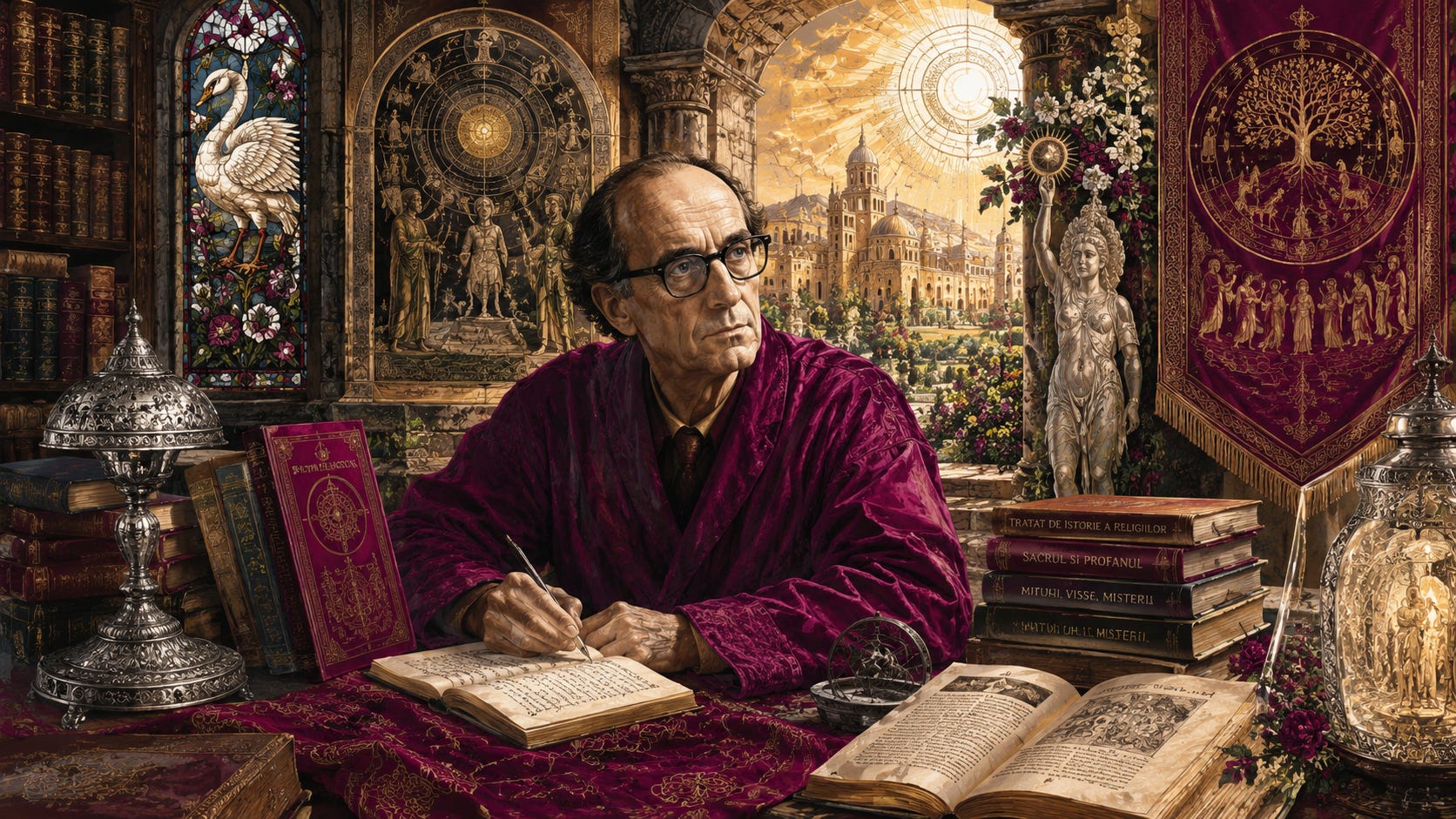
I. Eliade and the Persistence of the Sacred
Eliade begins with a distinction that gives shape to religious consciousness: the sacred and the profane. The profane names ordinary duration and ordinary extension, the daily field of practical life. The sacred names a break in that field, a charged manifestation of reality that orders the world around itself. A mountain becomes holy. A hearth becomes a center. A temple becomes the axis of the world. A calendar feast gathers the faithful into the time of beginnings.⁴
For Eliade, religious man inhabits a cosmos rather than a neutral field of objects. Sacred space gives orientation. Sacred time gives renewal. Myth recounts origins. Ritual repeats the exemplary act. Human action gains weight when it participates in a pattern older and higher than personal impulse. Man becomes more real by entering an order that precedes him.⁵
This vision matters because secular man often describes himself as emancipated from sacred order. He claims the vocabulary of reason, management, evidence, autonomy, preference, and public procedure. His practices reveal a deeper continuity. He continues to create sacred zones, sacred wounds, sacred identities, sacred phrases, sacred days, sacred texts, sacred persons, and sacred enemies. He keeps building altars, though many now come with fluorescent lights and compliance training.⁶
Eliade’s framework draws attention away from official labels and toward recurring forms. A movement functions religiously when it binds a people to an ultimate order through myth, ritual, authority, purification, and hope. The presence or absence of explicit theology matters, and structure matters as well. A secular movement can reject the word religion while performing the labor of religion.⁷
The first task, then, is descriptive honesty. Eliade teaches us to ask where the sacred appears and how human beings organize themselves around it. That question exposes the hidden architecture of modern public life. The temple can survive the demolition of the steeple. Sometimes it reappears as a committee room with snacks nobody enjoys.
II. The Modern Concealment of Religion
Secular modernity gains much of its power through the claim of neutrality. Its favored systems present themselves as reason, evidence, compassion, expertise, fairness, safety, or administration. They speak in procedural tones while advancing ultimate claims about personhood, guilt, innocence, purity, authority, and redemption. The voice sounds managerial. The structure sounds creedal.⁸
A secular religion binds a community to an ultimate moral order through myth, ritual, sacred authority, purification, and hope of redemption while avoiding the religious name. This definition requires restraint. A tax dispute remains a tax dispute. A traffic rule rarely conceals a cosmology, though some urban planners speak as if bike lanes had descended from the heavenly council. The category applies when a movement explains evil, assigns guilt, sacralizes certain persons or events, disciplines heresy, and promises deliverance.⁹
The concealed status creates an advantage over open religions. Christianity, Judaism, Islam, Hinduism, and Buddhism possess visible texts, rites, teachings, calendars, ascetic disciplines, and communities. Their religious nature stands in public view. A hidden religion speaks from behind a screen. It says its doctrines are education, its rituals are training, its priesthood is expertise, its taboos are safety, and its catechesis is awareness.¹⁰
Eliade clarifies the deception because his categories describe sacred form rather than official branding. A movement can avoid religious vocabulary while behaving religiously in space, time, myth, ritual, and social discipline. The mask becomes part of its authority. It declares itself neutral, then treats dissent as ignorance, harm, or moral disease.
Modern life contains many such systems. Their sanctuaries are less obvious than cathedrals. Their incense smells like printer toner.
III. Sacred and Profane in the Secular Age
Eliade’s sacred and profane distinction reveals the emotional intensity of modern secular politics. Human beings continue to divide the world into clean and unclean, protected and polluted, luminous and dangerous. Sacred boundaries remain active even when the culture translates them into psychological, political, or administrative language.¹¹
Woke ideology offers a clear case. Certain identities receive sacred status as carriers of moral authority. Certain historical wounds function as orienting events. Certain phrases become required speech. Certain questions become profanations. Certain jokes, books, statues, flags, classroom lessons, and digital gestures become sources of contamination. The logic is religious in form, even when the diction comes from sociology or policy.¹²
This structure explains why minor acts can trigger severe reactions. A speaker can pollute a campus. A statue can pollute a square. A phrase can pollute a workplace. An author can pollute a syllabus. A friendship can pollute a reputation. In older religious systems, impurity spreads through contact. In modern secular religions, moral pollution spreads through association, quotation, silence, or insufficient zeal.¹³
Eliade helps us see that these conflicts concern more than manners. They concern sacred order. Once a group treats speech as desecration and dissent as contamination, it has entered a religious field. The chosen language may be harm, safety, inclusion, or accountability. The function remains boundary protection.
The sacred has a talent for changing clothes. In our age, it often wears a lanyard.
IV. Myth as Sacred History
Eliade treats myth as a sacred account of origins. Myth tells how reality came to have its present shape and why human beings must act in a particular way. It reveals the exemplary event, the first rupture, the first victory, the first command, the first wound. Myth gives a community the story through which its world becomes legible.¹⁴
Secular religions require myth because they require a total account of meaning. Woke ideology tells a sacred history of oppression, awakening, struggle, and liberation. The world becomes intelligible through inherited domination. Evil resides in systems, structures, categories, language, memory, and power. The present appears as an extension of an original wound.¹⁵
This explains why historical debate becomes morally explosive. The conflict concerns sacred history rather than isolated facts. To challenge the myth is to disturb the moral order by which guilt, innocence, rank, authority, and redemption are assigned. Ordinary history asks what happened. Sacred history asks who bears guilt and who receives authority now.¹⁶
Eliade’s approach keeps the analysis from sinking into newspaper commentary. The question concerns the mythic use of history. A past event becomes ritually available in the present. It supplies identity, accusation, repentance, and mission. The archive becomes an altar. The citation becomes a matchstick. Academic prose, under certain conditions, can begin to smell faintly of burnt offering.
Woke mythology gains force because it joins moral drama to administrative power. The story descends into policies, curricula, hiring practices, speech norms, and symbolic rites. Myth becomes governance.
V. Sacred Time and the Eternal Return
Eliade’s account of sacred time gives the essay one of its central keys. Religious man seeks release from ordinary duration by returning to sacred beginnings. Through ritual, the community reenters the time of origins. The founding event becomes present. The faithful participate in the moment that gives reality its shape.¹⁷
Modern secular religions organize time in similar ways. Woke ideology returns repeatedly to selected wounds: slavery, colonialism, segregation, police violence, activist martyrdom, and symbolic dates. These events become more than historical subjects. They become sacred time, ritually summoned and morally reactivated.¹⁸
The effect is a collapse of chronology. The living confess for the dead. Public bodies apologize for acts committed generations before their current members existed. Schools, companies, cities, and agencies speak as though present administrators personally enacted ancient sins. The literal claim often strains ordinary reason. The ritual structure remains intelligible through Eliade.¹⁹
The eternal return explains why these acts repeat. The movement renews itself by returning to the wound. The sacred wound supplies authority, identity, accusation, solidarity, and mission. A healed wound would produce less ritual energy. A settled past would yield less priestly power. Repetition preserves the charge.²⁰
This pattern reveals the difference between historical remembrance and sacred recurrence. A society can study the past with sobriety. A secular religion reenters the past to regenerate its authority. The wound becomes calendar, catechism, and courtroom.
VI. Sacred Space and Administrative Territory
Eliade presents sacred space as the place where meaning descends and order becomes visible. The temple, shrine, holy city, altar, sacred mountain, or consecrated house gives orientation. Sacred space creates a center. It divides the ordered world from surrounding chaos.²¹
Modern secular religions create their own sacred spaces. The university becomes a precinct of moral formation. The classroom becomes a catechetical chamber. The corporate office becomes a ritual training ground. The protest site becomes a temporary shrine. The memorial becomes an altar of civic repentance. The social media profile becomes a pocket icon corner, although the icons often possess less majesty and more panic.²²
These spaces are guarded through language codes, access rules, symbolic gestures, required acknowledgments, and discipline for profanation. A speaker can desecrate a campus by appearing there. A statue can desecrate a square by remaining there. A book can desecrate a syllabus by being assigned. A joke can desecrate an office by being heard.²³
The administrative character of modern sacred space makes it harder to recognize. Older cultures openly consecrated churches, temples, shrines, and graves. Modern secular spaces declare themselves inclusive, safe, equitable, trauma-informed, and values-centered. The old boundary remains. The vocabulary changes.
Eliade allows us to identify the sanctuary hidden in the floor plan. A place becomes sacred when the community treats it as morally charged, ritually guarded, and vulnerable to profanation. The fact that the guardian carries a tablet rather than a censer changes the costume rather than the function.
VII. Ritual Purification and the Management of Guilt
Ritual, for Eliade, restores sacred order through repetition. It does more than express belief. It enacts the myth and returns participants to the pattern that grants reality. Through ritual, the community enters the sacred story and receives its shape again.²⁴
Secular religions create rituals because guilt requires management. Woke ideology uses confession, apology, acknowledgment, denunciation, diversity statements, sensitivity training, symbolic posting, public renunciation, and reeducation. These acts function as rites. They display submission to sacred order and mark the passage from impurity toward conditional restoration.²⁵
A diversity statement functions as a creed. A land acknowledgment functions as civic penance. A public apology functions as confession. A cancellation functions as expulsion of impurity. A training seminar functions as catechesis, with fluorescent lights taking the place of candles, a trade that proves modernity retains a taste for mortification.
The ritual often succeeds even when it fails to persuade. The purpose concerns performance, visibility, and discipline. The system observes who speaks, who repeats the formula, who hesitates, who asks forbidden questions, and who declines the rite. Ritual converts inward disposition into public evidence.²⁶
This explains the modern hunger for statements. Silence can function as refusal. Hesitation can signal impurity. Formulaic speech becomes a test of alignment. The creed may be stale, but stale bread can still be placed on an altar by people with sufficient administrative confidence.
VIII. Priests, Prophets, and Interpreters of the Hidden Order
Every religion develops interpreters of sacred order. Someone explains the myth, guards the boundary, identifies pollution, prescribes purification, and decides whether restoration has occurred. Authority gathers around the power to interpret the sacred.²⁷
Woke ideology has a distributed priesthood. It includes activist academics, DEI officers, journalists, HR officials, consultants, nonprofit managers, foundation staff, credentialed experts, and moral entrepreneurs. Their power is interpretive. They determine which words harm, which identities possess authority, which events govern the present, which apologies count, and which dissenters remain polluted.²⁸
This priesthood often gains strength through its informal character. It may lack robes, ordination, and apostolic succession, yet it controls hiring, curricula, publishing, invitations, platform access, reputational safety, and professional legitimacy. A priestly class that refuses priestly status can present doctrine as neutral expertise. The collar disappears. The authority remains.²⁹
Eliade’s framework clarifies the function. These interpreters mediate sacred order for formally secular bodies. They translate metaphysical claims into administrative commands. They transform myth into policy, ritual into training, impurity into risk, and heresy into harm.
The open pastor says, “This is doctrine.” The hidden priest says, “This is best practice.” Both make ultimate moral claims. One admits the altar exists.
IX. Heresy, Blasphemy, and Profanation
A disagreement concerns truth, prudence, or evidence. Heresy concerns betrayal of sacred order. Blasphemy concerns profanation of what a community treats as holy. This distinction explains the ferocity of many modern speech conflicts.³⁰
Woke ideology contains forbidden claims, forbidden questions, forbidden comparisons, forbidden silences, and forbidden jokes. The offender appears as polluted rather than mistaken. His words threaten communal cleanliness. His presence becomes dangerous. His job, invitation, publication, friendship, or reputation becomes a test of group purity.³¹
Apology functions within this sacred structure as confession. Yet confession brings risk. It confirms the presence of impurity. Restoration requires visible conversion, acceptance of the movement’s categories, submission to the interpreters, and performance of the proper rites. The accused kneels, and the congregation studies the angle.³²
Eliade helps us understand why these conflicts exceed ordinary etiquette. A secular religion polices sacred boundaries while calling the act safety or accountability. It enforces blasphemy codes while presenting them as conduct rules. It expels pollution while claiming to manage harm.
The old drama remains. Only the scenery changes. The stake has become a reputational spreadsheet, which is less picturesque and often more effective.
X. Woke Ideology as the Clearest Contemporary Case
Woke ideology offers the clearest contemporary example of a secular religion because its religious anatomy appears in concentrated form. It has sacred history in the story of oppression and liberation. It has original sin in privilege. It has inherited guilt in oppressor identities. It has saints and martyrs in victims whose stories become icons. It has demons in bigots, colonizers, patriarchs, fascists, and other figures of contamination. It has rites in confession, acknowledgment, apology, denunciation, training, cancellation, and symbolic solidarity. It has a priesthood in activists, administrators, academics, journalists, HR officers, and consultants. It has eschatology in the promised future of equity, inclusion, safety, and liberation.³³
This compact anatomy reveals the system. Woke ideology sacralizes identity, ritualizes guilt, mythologizes history, consecrates victimhood, polices profanation, and promises redemption through social reordering. Its power comes from joining religious intensity to administrative reach. It can preach, discipline, fund, hire, fire, educate, publish, shame, and exclude through bodies that describe themselves as secular.³⁴
John McWhorter has described contemporary antiracism as a religion, with dogma, original sin, clergy, and heresy. His account offers a useful secondary witness because it recognizes religious structure in a movement that presents itself as social analysis.³⁵ Eric Voegelin’s account of political religions also helps, since he saw modern ideological systems redirecting salvation into history. Woke ideology fits that pattern by promising a purified social order through political and moral reformation.³⁶
Eliade supplies the deeper grammar. He shows how the sacred returns in space, time, myth, ritual, taboo, and repetition. Woke ideology functions as religion because it organizes those forms. It provides a cosmos, a fall, a priesthood, a discipline, a mission, and a future. It is a faith with a talent for paperwork.
XI. Other Secular Religions Under the Eliadic Lens
Woke ideology serves as the main case, yet Eliade’s model reaches far beyond it. Modernity produces many secular religions because human beings continue to seek sacred order. When older sacred orders lose public authority, rival orders arise with fresh names and familiar demands.³⁷
Nationalism becomes religious when the nation becomes sacred, founders become saints, war dead become martyrs, enemies become demons, and national rebirth becomes salvation. Patriotism can honor fathers, land, law, and inheritance. Nationalist religion goes further by giving the nation ultimate rank. The flag becomes icon, battlefield becomes altar, and defeat becomes apocalypse.³⁸
Technocracy becomes religious when experts become priests, data becomes revelation, policy becomes sacrament, and human life becomes material for managerial salvation. The technocrat dreams of a world purified through procedure. He is the sort of man who could stand before the Burning Bush and request a dashboard.
Market ideology becomes religious when the market becomes providence, wealth becomes election, and price signals become oracles. Therapeutic liberalism becomes religious when emotional safety becomes salvation, trauma becomes sacred identity, and self-expression becomes redemption. Each system creates myths, rituals, taboos, authorities, and hopes.³⁹
Robert Bellah’s account of American civil religion shows how public life can generate sacred symbols, martyrs, texts, rites, and providential stories within a formally secular republic.⁴⁰ Eliade’s model widens that insight. It teaches us to examine how any movement organizes sacred value. The test concerns behavior rather than branding. The faith may carry a cross, a flag, a spreadsheet, a slogan, or a therapeutic worksheet. The structure tells the tale.
XII. Why False Religions Attack Open Religions
False religions attack open religions because open religions reveal the borrowed sacredness of their rivals. Christianity, Judaism, Islam, Hinduism, and Buddhism place their claims in visible form. They have scriptures, rites, calendars, doctrines, teachers, ascetic disciplines, and communities. Their sacred order can be examined and challenged.⁴¹
Hidden religions avoid that honesty. They present doctrine as education, metaphysics as safety, anthropology as science, morality as policy, and conversion as awareness. When Christianity resists, the hidden religion often describes Christian doctrine as harm, irrationality, extremism, bigotry, or backwardness. It treats Christianity as religion while treating itself as reality.⁴²
Christianity is especially threatening because it brings a rival account of creation, sin, personhood, repentance, mercy, justice, authority, and judgment. It claims that Christ rules every power and every conscience. It places ultimate authority above the managerial order. This makes Christianity more than a private comfort or heritage marker. It becomes a public truth claim with a sovereign Lord at its center.⁴³
False religions can tolerate Christianity as music, architecture, charity, folklore, therapy, or ethnic memory. They resist Christianity as doctrine. They prefer the church as soup kitchen, concert hall, museum, or moral chaplain. They bristle when the Church speaks as the Body of Christ.
The first Christian act is naming. A rival religion should receive a religious name when it performs religious work. This is category discipline. It keeps the sacred from hiding inside administrative fog.
XIII. The Christian Response to Secular Religion
The Christian response to secular religion is clarity, courage, beauty, and liturgical seriousness. Christians should identify secular religions by structure. They should refuse the fiction that public life operates without sacred assumptions. Schools, courts, corporations, media bodies, charities, and agencies all carry moral orders. The question concerns which sacred order governs them.⁴⁴
The Church should speak from her own categories: creation, fall, sin, repentance, grace, incarnation, holiness, judgment, mercy, communion, and the Kingdom of God. Borrowed vocabulary often becomes a borrowed cage. When Christianity accepts a rival’s moral grammar, it begins the argument inside another temple.⁴⁵
The Church must recover the strength of her own sacred order. Thin Christianity invites counterfeit liturgies. Embarrassed Christianity leaves its children vulnerable to rival catechisms. A parish with weak worship, weak teaching, weak fasting, weak household discipline, and weak communal life should expect the world to disciple its people with grim delight. The world never forgets to catechize. It only forgets mercy.⁴⁶
Christianity possesses sacred time in the liturgical year, sacred space in the church, purification in baptism and confession, moral formation through ascetic discipline, and redemption through Christ. It needs no seminar to discover guilt. It has the Cross.⁴⁷
The answer to false religion is true religion practiced with intelligence, majesty, and courage. The return of secular religion reveals hunger for sacred order. That hunger has been misdirected in many places, yet it still reveals man’s vocation toward worship.
XIV. The Eternal Return to Eliade
Eliade brings the whole argument back to its center. The sacred returns. Modern man can privatize it, politicize it, bureaucratize it, therapize it, or bury it under administrative speech. He still makes sacred spaces, sacred histories, sacred wounds, sacred authorities, sacred rituals, sacred taboos, and sacred futures.⁴⁸
The basic question for society concerns which religion will order memory, discipline guilt, govern speech, rank persons, purify pollution, and define hope. The sacred will take form. It will generate rites, guardians, martyrs, offenders, calendars, doctrines of impurity, and visions of salvation. Even when it arrives through a committee, it arrives.⁴⁹
Woke ideology offers the clearest current example because it contains an unusually complete structure. Eliade’s categories reveal sacred time in recurring historical wounds, sacred space in protected campuses and offices, myth in the story of oppression and liberation, ritual in confession and cancellation, priesthood in interpreters of harm, pollution in forbidden speech, and eschatology in the promised world of equity and safety.⁵⁰
Yet Eliade’s value exceeds that single case. He reveals modernity as a theater of displaced religion. The sacred has migrated into politics, therapy, nationalism, technocracy, market order, education, and bureaucracy. Every serious civilization answers sacred order. The only question concerns whether that answer is named, disciplined, and true, or hidden, coercive, and false.⁵¹
Modernity did less to bury religion than to change its clothing. Eliade helps us recognize the garments. He returns us to the first act of sanity: name the sacred where it appears, name the ritual where it operates, name the priesthood where it governs, and name the rival faith where it seeks converts under another title.
Notes
¹ Mircea Eliade, The Sacred and the Profane: The Nature of Religion, trans. Willard R. Trask (New York: Harcourt, Brace & World, 1959), 20–65.
² Émile Durkheim, The Elementary Forms of Religious Life, trans. Karen E. Fields (New York: Free Press, 1995), 34–44. Durkheim’s social account of religion differs from Eliade’s phenomenological account, yet both help identify sacred boundaries within communal life.
³ Eliade, The Sacred and the Profane, 11–19; Mircea Eliade, Myth and Reality, trans. Willard R. Trask (New York: Harper & Row, 1963), 5–23.
⁴ Eliade, The Sacred and the Profane, 20–65.
⁵ Mircea Eliade, The Myth of the Eternal Return: Cosmos and History, trans. Willard R. Trask (Princeton: Princeton University Press, 1954), 3–48.
⁶ Eliade, The Sacred and the Profane, 68–113. This note applies Eliade’s pattern to present civic and administrative life.
⁷ Eliade, Myth and Reality, 5–23.
⁸ Charles Taylor, A Secular Age (Cambridge, MA: Belknap Press of Harvard University Press, 2007), 1–22.
⁹ Philip Rieff, The Triumph of the Therapeutic: Uses of Faith After Freud (Chicago: University of Chicago Press, 1987), 1–27.
¹⁰ Robert N. Bellah, “Civil Religion in America,” Daedalus 96, no. 1 (Winter 1967): 1–21.
¹¹ Eliade, The Sacred and the Profane, 10–18.
¹² Mary Douglas, Purity and Danger: An Analysis of Concepts of Pollution and Taboo (London: Routledge, 1966), 35–57.
¹³ Douglas, Purity and Danger, 44–50. Douglas’s account of pollution as disorder helps explain why modern ideological cultures treat speech, association, and symbols as contagious.
¹⁴ Eliade, Myth and Reality, 5–18.
¹⁵ John McWhorter, Woke Racism: How a New Religion Has Betrayed Black America (New York: Portfolio, 2021), 1–28.
¹⁶ Eliade, Myth and Reality, 18–36. Eliade’s account gives sacred history a sharper meaning than ordinary political storytelling.
¹⁷ Eliade, The Sacred and the Profane, 68–113.
¹⁸ Eliade, The Myth of the Eternal Return, 49–92.
¹⁹ Eliade, The Sacred and the Profane, 70–76. This explanatory note applies Eliade’s treatment of ritual reentry into sacred time to modern acts of corporate, civic, and academic confession.
²⁰ Eliade, The Myth of the Eternal Return, 85–112.
²¹ Eliade, The Sacred and the Profane, 20–65.
²² Bellah, “Civil Religion in America,” 1–21. Bellah’s account of civic symbolism helps bridge Eliade’s archaic sacred space and modern public rites.
²³ Douglas, Purity and Danger, 1–6, 35–57.
²⁴ Eliade, The Myth of the Eternal Return, 21–48.
²⁵ René Girard, Violence and the Sacred, trans. Patrick Gregory (Baltimore: Johns Hopkins University Press, 1977), 1–39.
²⁶ Rieff, The Triumph of the Therapeutic, 24–42. Rieff helps explain how public therapeutic language absorbs older forms of confession and moral discipline.
²⁷ Eliade, Myth and Reality, 122–41.
²⁸ McWhorter, Woke Racism, 29–71.
²⁹ Eric Voegelin, The Political Religions, trans. T. J. DiNapoli and E. S. Easterly (Lewiston, NY: Edwin Mellen Press, 1986), 23–44.
³⁰ Douglas, Purity and Danger, 115–40.
³¹ Girard, Violence and the Sacred, 79–111.
³² Girard, Violence and the Sacred, 112–45. Girard’s account of communal relief through expulsion illuminates modern cancellation rituals while preserving Eliade’s broader sacred frame.
³³ McWhorter, Woke Racism, 1–28, 72–112.
³⁴ Voegelin, The Political Religions, 55–72.
³⁵ McWhorter, Woke Racism, 1–28.
³⁶ Voegelin, The Political Religions, 23–72.
³⁷ Taylor, A Secular Age, 539–93.
³⁸ Bellah, “Civil Religion in America,” 1–21.
³⁹ Rieff, The Triumph of the Therapeutic, 1–27; Taylor, A Secular Age, 473–504.
⁴⁰ Bellah, “Civil Religion in America,” 1–21.
⁴¹ Eliade, The Sacred and the Profane, 162–213.
⁴² Taylor, A Secular Age, 1–22, 539–93.
⁴³ Matthew 28:18–20; Colossians 1:15–20. This theological note identifies the Christian claim that all authority and all creation find their center in Christ.
⁴⁴ Taylor, A Secular Age, 539–93.
⁴⁵ Rieff, The Triumph of the Therapeutic, 24–42.
⁴⁶ Alexander Schmemann, For the Life of the World: Sacraments and Orthodoxy (Crestwood, NY: St. Vladimir’s Seminary Press, 1973), 11–22.
⁴⁷ Schmemann, For the Life of the World, 23–46. Schmemann’s sacramental account of Christian life provides a constructive counterpoint to secular ritual systems.
⁴⁸ Eliade, The Sacred and the Profane, 162–213.
⁴⁹ Eliade, The Myth of the Eternal Return, 112–62.
⁵⁰ Eliade, The Sacred and the Profane, 20–113; McWhorter, Woke Racism, 1–112.
⁵¹ Eliade, Myth and Reality, 162–93. This final note returns the essay to Eliade’s account of modern survivals and changes of myth.
Bibliography
Bellah, Robert N. “Civil Religion in America.” Daedalus 96, no. 1 (Winter 1967): 1–21.
Douglas, Mary. Purity and Danger: An Analysis of Concepts of Pollution and Taboo. London: Routledge, 1966.
Durkheim, Émile. The Elementary Forms of Religious Life. Translated by Karen E. Fields. New York: Free Press, 1995.
Eliade, Mircea. Myth and Reality. Translated by Willard R. Trask. New York: Harper & Row, 1963.
Eliade, Mircea. The Myth of the Eternal Return: Cosmos and History. Translated by Willard R. Trask. Princeton: Princeton University Press, 1954.
Eliade, Mircea. The Sacred and the Profane: The Nature of Religion. Translated by Willard R. Trask. New York: Harcourt, Brace & World, 1959.
Girard, René. Violence and the Sacred. Translated by Patrick Gregory. Baltimore: Johns Hopkins University Press, 1977.
McWhorter, John. Woke Racism: How a New Religion Has Betrayed Black America. New York: Portfolio, 2021.
Rieff, Philip. The Triumph of the Therapeutic: Uses of Faith After Freud. Chicago: University of Chicago Press, 1987.
Schmemann, Alexander. For the Life of the World: Sacraments and Orthodoxy. Crestwood, NY: St. Vladimir’s Seminary Press, 1973.
Taylor, Charles. A Secular Age. Cambridge, MA: Belknap Press of Harvard University Press, 2007.
Voegelin, Eric. The Political Religions. Translated by T. J. DiNapoli and E. S. Easterly. Lewiston, NY: Edwin Mellen Press, 1986.