
Evolution Is Not a Scientific Theory
Why Darwinism and its derivatives belong to unscientific historicism

I. The modern priesthood calls its story science
-From a heretic of the liberal order
Evolution enjoys a peculiar public status. It is presented as a scientific theory, defended as settled knowledge, and used as a sorting mechanism for determining who belongs among the respectable. The ordinary man is not invited to examine its category. He is told to genuflect before it. The lab coat has become vestment. The clipboard has learned Latin.
The first distinction must be made with care. Observable biological change is real. Bacteria adapt. Breeders select. Viruses mutate. Populations shift. These matters can be watched, measured, tested, and repeated.
The dispute concerns the grand story.
The grand evolutionary account claims to explain the vast history of life across deep time: the origin, branching, adaptation, and ascent of living forms from ancient beginnings to present complexity. That is not the same sort of claim as a laboratory result. It is a reconstruction of natural history from fossils, genes, morphology, and inferred sequence. Even defenders of evolution describe the fossil record as a set of “snapshots” assembled into a broader picture of change. That phrase matters. Snapshots require interpretation. They do not speak in complete paragraphs. Fossils are quiet little witnesses, and paleontologists have to play courtroom stenographer.
Science tests causes.
Evolution arranges remains.
The modern confusion begins when natural history is treated as experimental science because both use evidence. This is the same hidden-room problem that appears whenever a tool changes the order of knowledge: the evidence is real, but the access is mediated.
That mediation is the issue.
As Paul Kingsnorth has argued in another register, modern man often mistakes myth for falsehood, when myth is really the story by which a civilization interprets itself (Kingsnorth, 2024). Evolution has become such a story. Its cultural power comes from that role.
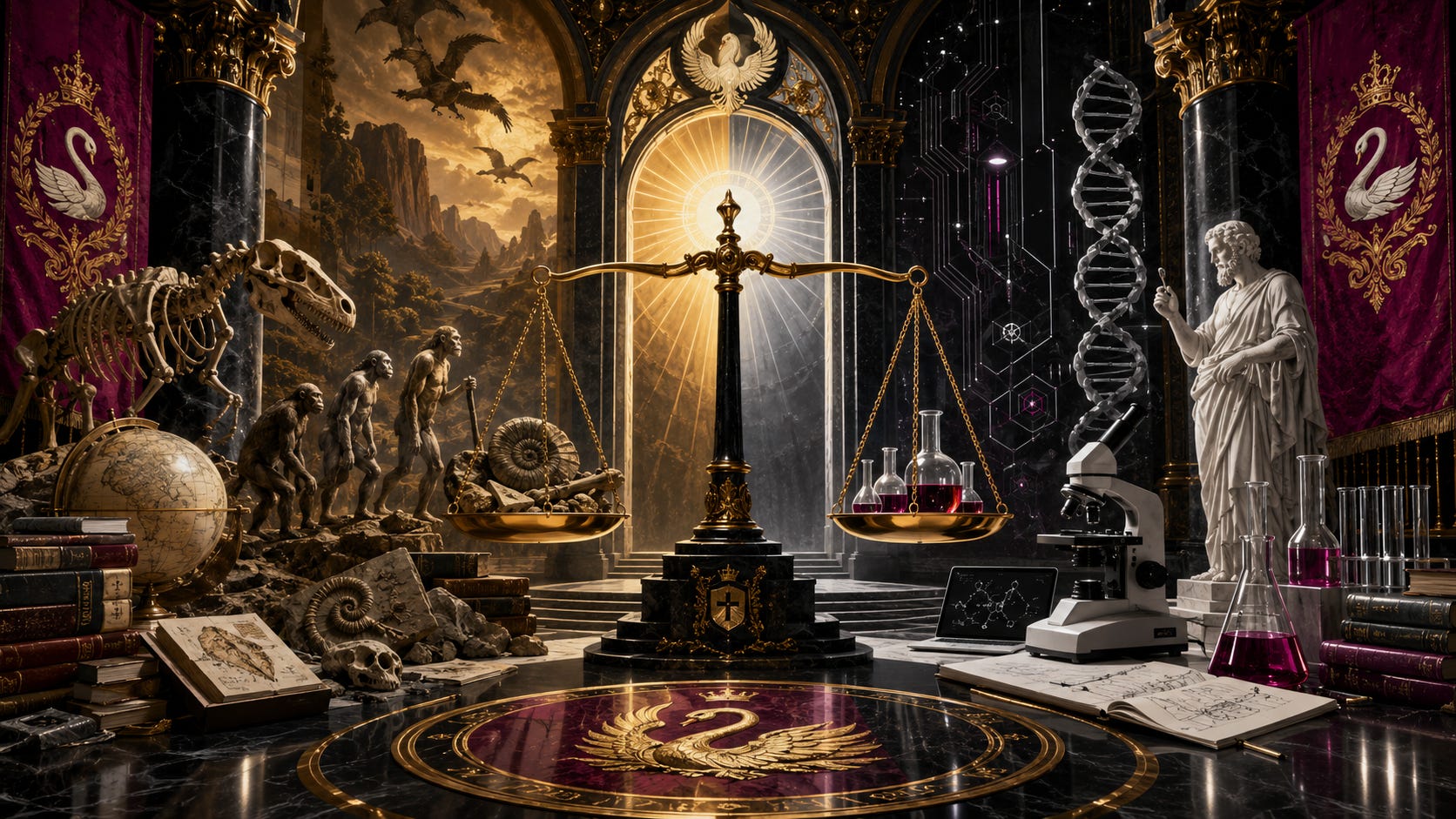
II. Science requires repeatable testing
Evolution’s greatest proponents would fail their kinematics exams.
The older meaning of science carries discipline in its bones. It begins with observation, forms hypotheses, generates predictions, tests them, and returns to the matter under controlled conditions. When chemistry predicts a reaction, the reaction can be repeated. When physics predicts acceleration, the experiment can be run again by another man in another room with another apparatus and the same stubborn gravity.
Repeatability does not solve every problem in science. The philosophy of science contains serious disputes about reproducibility, replication, and the limits of method. Yet the value of repeated testing remains central because it protects inquiry from private impression, scholarly fashion, and the small tyrannies of clever prose.
Deep evolutionary history does not operate this way. No one can rerun the Devonian. No committee can restart the Cambrian explosion. No university department can place trilobites, jawless fish, gymnosperms, theropods, mammals, and man into a glass chamber and observe universal common descent unfold under controlled conditions. If it could, the grant application would need its own postal code.
A laboratory can test a mechanism.
It cannot resurrect an epoch.
This does not make historical reconstruction worthless. It makes it historical.
The moral distinction resembles the warning found in the old automation lesson: the command is only as sound as the judgment behind it. Evidence does not remove judgment. It multiplies the force of judgment already present.
Rod Dreher’s work on wonder makes a similar civilizational point: a disenchanted age still lives by stories, even when it pretends to have outgrown them (Dreher, 2024). Evolutionary history is one of those stories.
III. Natural history is description, not experiment
TLDR: History and science are different things.
Natural history observes the world as received. It classifies organisms, compares structures, collects fossils, traces distribution, and arranges living things into intelligible order. This work has majesty. It is an old and noble labor. A naturalist with a notebook and a weathered coat may see more truth in a marsh than a bureaucrat sees in seventy funded panels.
Still, natural history is not experimental science in the strict sense. It is descriptive, comparative, and interpretive. It works with traces. It gathers evidence from the present and from preserved fragments of the past, then proposes a sequence by which those fragments might be related.
The National Academies defend evolution by appealing to fossil records, DNA, common ancestry, and natural selection as converging evidence. That formulation is important because convergence is inferential. Evidence is placed into a structure. The structure is judged persuasive. The conclusion is not produced by direct repetition of the full historical process.
A fossil sequence is not a controlled experiment.
A reconstructed lineage is not a physics equation.
Natural history gathers the bones; evolution writes the family drama.
The comparison is not an insult. It is a classification. Calling a cathedral a courthouse would not make the cathedral less grand. It would make the speaker less useful around architecture.
This is where the voice betrays the soul. Evolutionary rhetoric often speaks with the confidence of experimental science while using the method of historical interpretation.
Patrick Deneen’s critique of modern liberal thought helps clarify the pattern: modern systems often turn their assumptions into social authority, then punish those who notice the conversion (Deneen, 2018).
IV. Microevolution is real, limited, and testable
An introduction to the could-did distinction.
A serious critique must concede what is visible. Small-scale biological change happens. Antibiotic resistance appears. Selective breeding produces altered traits. Viral populations mutate. Allele frequencies change across generations. These are observable processes. They belong within ordinary science.
This is why the careless rejection of “evolution” as a single mass of falsehood weakens the argument. The word carries several meanings. It can mean minor change within populations. It can mean natural selection as a mechanism. It can mean common descent. It can mean the whole sacred mural of life climbing from the primordial mud to tenure. One word is being made to pull a wagonload of claims. The poor thing is sweating through its collar.
Berkeley’s evolution materials make this range visible by presenting both mechanisms and deep historical patterns under the same educational heading. That is where confusion enters. A tested mechanism is treated as evidence for an enormous historical account. The local observation is made to sponsor the cosmic narrative.
A dog breeder proves variation.
He does not prove Genesis according to Darwin.
The problem is not that adaptation is unreal. The problem is that adaptation is used as a bridge to claims far larger than the experiment can carry.
The same lesson appears in the warning about the sorcerer’s command: a tool magnifies the judgment already placed inside it. Microevolution is the tool. Universal history is the judgment.
Kingsnorth’s critique of the Machine is useful here because modern thought often treats mechanism as destiny (Kingsnorth, 2023). A mechanism explains less than modern man wants it to explain.
V. Macroevolution is a historical inference
Evolution fails the repeatability criteria for scientific inquiry.
Macroevolution concerns large-scale change across major forms of life over deep time. The evidence offered for it includes fossils, anatomical similarities, molecular comparisons, biogeography, and observed small-scale change. These are serious materials. They deserve examination. They do not deserve automatic category promotion.
The central point is simple. The full sequence is inferred. It is not directly observed.
Even the strongest evolutionary presentations speak in terms of reconstructing the story of life through multiple lines of evidence. Berkeley’s materials describe the history of living things as something documented by lines of evidence that “converge” to tell a story through time. That is the language of reconstruction. It may be careful. It may be sophisticated. It may be persuasive to many specialists. Yet it remains a historical inference from available traces.
The fossil record is evidence.
The story attached to it is interpretation.
This matters because interpretation is never free from metaphysical preference. The interpreter brings assumptions about causation, continuity, analogy, chance, necessity, and what sorts of explanations are allowed into the room. He may wear gloves. His fingerprints remain.
The hidden room is never empty.
The larger the historical claim, the more the framework governs the evidence. A single bone may be measured. A lineage must be narrated.
Dreher’s concern with false enchantment helps here: a culture that denies religious structure often builds substitute enchantments out of respectable material (Dreher, 2024). Macroevolution has become one of those respectable enchantments.
VI. Historicism mistakes sequence for cause
Evidence has always been a phenomenon.
Historicism is the habit of explaining reality by placing events inside a governing historical process. The event becomes intelligible because of where it falls in the sequence. Past, present, and future are joined into a narrative machine. The gears turn, and men begin calling the gears truth.
That habit is older than Darwin, but Darwinism gave it biological force.
The Stanford Encyclopedia’s treatment of historical rationality shows how deeply modern philosophy of science has wrestled with the role of history in scientific judgment, especially through debates after Kuhn. History can illuminate science. It can also tempt men to mistake a successful narrative for a demonstrated cause.
Evolutionary reasoning often works this way. Organisms are explained by their presumed developmental place in natural history. Traits are understood by the survival story attached to them. The timeline becomes the explanatory engine.
A timeline is not a laboratory with better handwriting.
Sequence can suggest relation. It cannot by itself establish cause.
The problem becomes acute when order is treated as proof of mechanism. Fossils in sequence may support a claim about change. They do not, by sequence alone, demonstrate that a particular mechanism generated the whole order of life.
The older lesson about automation says the command reveals the master. Historicism reveals the same thing. The sequence reveals the interpreter.
Deneen’s critique of modern autonomy applies by analogy: when a culture treats inherited order as raw material for theory, it often mistakes abstraction for mastery (Deneen, 2018).
VII. Darwinism turns gaps into promissory notes
The religion of Liberalism needed a creation account. Darwin supplied it.
Every historical reconstruction contains gaps. That is normal. The past does not preserve itself for modern convenience. Nature has never behaved like a graduate assistant.
The issue is how the theory treats gaps.
When the fossil record is incomplete, the gap is often treated as temporary. When the mechanism appears insufficient, future research is invoked. When a pattern resists the expected sequence, the framework bends. Some flexibility is proper. No serious field should collapse at the first awkward specimen. Still, a theory can become so elastic that it ceases to face danger.
The National Academies argue that the claim about fossil gaps undermining evolution is false and point to predicted transitional discoveries such as Tiktaalik. That is the strongest version of the defense: evolutionary theory can guide discovery. This deserves recognition.
Yet the philosophical question remains. How much contrary arrangement could the theory absorb before it stopped being treated as true?
A theory that cannot be embarrassed has joined polite society and left science behind.
Karl Popper famously criticized natural selection as, at least at one stage in his thinking, a metaphysical research program rather than a testable scientific theory, though later interpreters have debated exactly what he meant and how far that claim extends. The phrase is useful because it places Darwinism in the category of guiding framework.
Kingsnorth’s writing on myth clarifies the point: myths do not vanish in modernity. They put on clean shoes (Kingsnorth, 2024).
VIII. Evolutionary language smuggles in purpose
There is no such thing as a value-neutral judgment.
Darwinian explanation officially rejects teleology. Nature has no conscious aim. Evolution has no final plan. Natural selection does not think, intend, design, or bless. The doctrine is blind mechanism.
Yet the language of evolution constantly borrows the grammar of purpose.
Organs are “for” survival. Traits are “selected for.” Species “adapt” to conditions. Nature “solves” problems. Evolution “experiments.” Organisms “develop strategies.” The wording is so common that no one notices the little metaphysical raccoon stealing eggs from the henhouse.
Some of this is shorthand. No biologist needs to be accused of believing that Nature sits at a mahogany desk with minutes from the last meeting. Even so, persistent shorthand reveals conceptual pressure. The explanation wants purpose-shaped speech because living systems appear purpose-shaped.
Darwin banished purpose from biology, then left its coat on the chair.
This problem does not refute every evolutionary claim. It exposes the strain inside the explanatory language. A blind process is described as if it sees because the phenomena keep looking seen.
The moral danger resembles the voice problem in technological life: something intimate can be copied, used, and rearranged while the user pretends the deeper question has disappeared. Teleological language is the copied voice of purpose.
Dreher’s work on recovering wonder in a disenchanted world gives the stronger frame (Dreher, 2024). The living world still provokes wonder. Darwinism tries to discipline that wonder into mechanism, but the wonder keeps slipping through the bars.
IX. Evolution functions as a modern origin myth
It’s not a religion! We call it something else!
A society needs an origin story. It needs to tell its children where they came from, what man is, what the world means, and what kind of life deserves honor. Ancient peoples gave mythic answers. Modern people give credentialed answers. The function remains.
Evolution now serves this role for secular modernity.
It explains man without Adam, order without Logos, life without creation, morality without command, and inheritance without piety. It allows modern culture to regard religion as primitive, hierarchy as accidental, sex as reproductive machinery, family as temporary arrangement, and man as clever animal with tax paperwork.
That is mythic territory.
Every civilization has a creation story.
Ours wears a lab coat and asks for tenure.
This does not mean every evolutionary biologist is consciously writing myth. Most are doing technical work within a received framework. The mythic power appears when the theory leaves biology and becomes anthropology, ethics, politics, and metaphysics. At that point, Darwinism is no longer confined to explaining finch beaks. It is explaining man.
The automation lesson applies again: machinery magnifies the judgment behind the command. Evolutionary theory magnifies the metaphysical judgment behind modernity.
Paul Kingsnorth’s “All the World is Myth” is plain on this point: man lives by story even when he claims to live beyond story (Kingsnorth, 2024). Deneen’s critique of liberal modernity adds the political half: modern accounts of freedom and nature build societies in their own image (Deneen, 2018).
The origin myth becomes the civic operating manual.
X. The better category is disciplined historical interpretation
Postmodernism is a solvent that corrodes its container.
Evolution should be stripped of false grandeur and false immunity. It should be studied as disciplined natural-historical interpretation. That category grants it evidence, method, debate, and intellectual seriousness. It removes the borrowed authority of experimental science when the claim concerns unrepeatable deep history.
This classification also protects real science.
Observable adaptation remains testable. Genetics remains powerful. Field biology remains fruitful. Fossil study remains meaningful. None of that requires the grand historical narrative to be treated as if it were chemistry, mechanics, or molecular biology.
The distinction is clean.
Evolution as small-scale change belongs in the laboratory and the field.
Evolution as universal natural history belongs among reconstructions of the past.
The first can be tested directly. The second must be inferred.
This is why the public rhetoric around evolution is so telling. When challenged, defenders often move between meanings. They begin with bacterial resistance, pass through common descent, arrive at a total history of life, and then act offended when someone notices the luggage has changed color.
Evolution is not nothing.
It is something far more dangerous to call science without qualification: a story about everything.
The hidden room remains hidden when categories are blurred.
A Christian order in the age of technological modernity must recover the courage to name things correctly. Kingsnorth’s critique of the Machine, Dreher’s defense of wonder, and Deneen’s attack on liberal metaphysics converge here: modern man is most dominated by the stories he refuses to call stories (Kingsnorth, 2023; Dreher, 2024; Deneen, 2018).
Evolution should be studied as natural history, debated as historical interpretation, and relieved of its priestly office.
Bibliography
Berkeley Understanding Evolution. “Evolution 101.”
Berkeley Understanding Evolution. “Fossil Evidence.”
Berkeley Understanding Evolution. “Lines of Evidence.”
Deneen, Patrick J. 2018. Why Liberalism Failed. Yale University Press. See overview and author background.
Dreher, Rod. 2024. “The Urgency of Living in Wonder.” Rod Dreher’s Diary.
Guildrim. 2026. “What Bluebeard Teaches Us About the Hidden Room.”
Guildrim. 2026. “What the Little Mermaid Teaches Us About AI Voice Tools.”
Guildrim. 2026. “What the Sorcerer’s Apprentice Teaches Us About Automation.”
Kingsnorth, Paul. 2023. “The Tale of the Machine.” The Abbey of Misrule.
Kingsnorth, Paul. 2024. “All the World is Myth.” The Abbey of Misrule.
National Academies. “Evidence Supporting Biological Evolution.”
National Academies. “Evolution Resources.”
National Center for Science Education. “What Did Karl Popper Really Say About Evolution?”
Stanford Encyclopedia of Philosophy. “Historicist Theories of Scientific Rationality.”
Stanford Encyclopedia of Philosophy. “Reproducibility of Scientific Results.”