
Christians Must Abandon Debate
How participation in liberal ritual reinforces Christianity's subjugation

I. Christians are correct about the attack and mistaken about the weapon.
Many Christians believe Christianity is under attack.
They are right.
Their response is worse than retreat, because retreat at least preserves the possibility of regrouping. The modern Christian instinct is to enter debate, as though the public square were a neutral hall, as though the rules were impartial, as though the judge were asleep in another room rather than sitting on the bench wearing a powdered wig made of Enlightenment fog.
The danger is real. The diagnosis is partial.
Christendom has been reduced from sacred order to permitted opinion. The Church is tolerated so long as she speaks as one lifestyle association among many. She may advise. She may inspire. She may provide ceremonies for sentimental persons who still like candles and Latin-looking things. She may decorate private feeling.
She may not rule.
That is the settlement.
The Christian who enters debate under liberal terms accepts the sacred settlement before he opens his mouth. He accepts Christianity as a claim awaiting permission. He accepts liberalism as referee. He accepts the fiction that Christ must make His case before the tribunal of neutral reason, as though the Lord of Glory were a defendant charged with insufficient modernity.
A throne cannot be defended as a hobby.
Mircea Eliade understood that man is liturgical before he is analytical. Human beings inhabit sacred space. They repeat founding gestures. They receive time through rites. They learn reality through participation. Modernity claims to have abolished sacred order, yet it merely hides its altars behind microphones, procedures, panels, and public norms. The modern man who rejects gods still needs meaning, purity, origin, sacrifice, and final hope.
This is the first mistake Christians make. They think they are contesting arguments.
They are entering rites.
II. A method that returns forever while losing forever has judged itself.
The debate strategy has been tested.
It has failed.
This is a simple matter, though committees do have a talent for breeding fog in jars. For generations, Christians have debated secular liberals, progressives, atheists, bioethicists, technocrats, school boards, judges, journalists, professors, activists, and professional scolders with advanced degrees in moral ventriloquism.
The result has been endless retreat with better footnotes.
The public law grows more secular. The schools grow more hostile. The family grows weaker. Sacred art disappears into the museum. Marriage becomes a contract of affection. Children become lifestyle accessories. The machine grows larger, and Christians, having lost the old order, console themselves with clips of a clever answer given under stage lights.
A clever answer is not a kingdom.
The constant return to debate proves the weakness of the method. Christians debate abortion, then debate the family, then debate marriage, then debate the meaning of male and female, then debate whether children belong to parents or to administrative experts. Every defeat becomes another invitation to explain the previous defeat politely.
A sane civilization does not debate its own bloodstream.
The issue is structural. Debate assumes shared premises. Liberalism and Christianity do not share premises. Christianity begins with revelation, incarnation, hierarchy, sin, grace, judgment, and the kingship of Christ. Liberalism begins with the sovereign individual, procedural neutrality, private preference, and public management.
These are rival sacred orders.
The debate stage belongs to the religion whose sacred language names the terms. Freedom, dignity, rights, safety, harm, democracy, equality, inclusion, and recognition do more than describe. They bless. They condemn. They mark the holy and the profane.
A debate between them under liberal rules is already a liberal victory.
III. Liberalism is a religion, and debate is one of its rites.
Liberalism is a rival religion with bad vestments.
It has a doctrine of man, a doctrine of sin, a doctrine of salvation, a priesthood, sacred texts, excommunications, purification rites, holy days, taboos, martyrs, relics, and a paradise. Its doctrine of man is the autonomous individual. Its doctrine of sin is domination, exclusion, and inherited obligation. Its salvation is emancipation from unchosen bonds. Its priesthood is the managerial class. Its liturgy is procedure. Its paradise is a world where every person is free from every authority except the ones issuing guidelines.
Very tidy. Very sterile. A hospital chapel with no altar and excellent signage.
Eliade’s value here is surgical. He shows that the sacred survives under new names. The holy does not evaporate because a society purchases fluorescent lights and starts saying “policy.” The sacred migrates. It moves into language, office, screen, court, classroom, credential, and public ceremony. Liberalism performs this migration while insisting that it is merely neutrality, which is a rather elegant trick, like stealing a horse and charging admission to see the empty stable.
Debate is one of its rites.
In the liberal imagination, debate stages the sacred drama of rational agents meeting as equals, exchanging propositions, suspending inherited authority, and submitting every claim to public reason. The ritual performs the liberal doctrine of man. It shows the individual liberated from throne, altar, father, village, custom, and tradition. He stands alone with arguments. He consents only to what he has judged for himself.
This is the liberal theophany.
The god appears as process.
Christians who enter this rite to defend Christianity have already entered a temple built for another deity. They may speak of Christ there, but the architecture preaches Locke.
The hidden altar remains in the room.
The room wins before the sentence begins.
IV. Debate reveals liberalism’s false god: the rational actor choosing truth.
The ritual of debate depends on a false anthropology.
It imagines man as a rational actor who encounters claims, weighs evidence, and then chooses truth according to neutral reason. This fantasy is cherished by people who cannot choose a sandwich without consulting three reviews and a friend named Madison.
Man is not a floating intellect.
He is a creature of worship, habit, appetite, loyalty, fear, inheritance, memory, and desire. He is born into language, family, place, custom, obligation, and imagination before he ever learns formal argument. By the time he can “think for himself,” most of the self doing the thinking has already been formed.
Eliade helps expose the fraud. Man becomes himself through orientation toward the sacred. He needs a center. He needs a world arranged by meaning. He needs acts that tell him where heaven meets earth, where time begins again, where chaos ends and order starts. Liberal debate pretends to suspend all sacred centers so reason can operate in neutral space.
Neutral space is a myth with carpeting.
Every debate has a sacred center. Every platform has a priesthood. Every moderator guards a moral order. Every question smuggles in a hierarchy. The debate about Christianity inside liberal space already treats Christianity as one proposition among rival propositions, rather than the form of life through which propositions receive their proper rank.
That is the concession.
Christianity cannot be reduced to a conclusion at the end of an argument. It is a world. It is baptismal water, bread and wine, fasting and feasting, father and mother, icons and graves, law and mercy, sin and absolution, household and parish, king and martyr, chant and silence, birth and burial under the sign of the Cross.
Debate shrinks this majesty into a claim.
The Cross becomes content.
The liberal frame cannot perceive Christian order because Christian order is larger than the frame. The whole problem resembles trying to inspect a cathedral through a keyhole, then complaining that the nave lacks scale.
Eliade’s central point, applied to liberalism, is that people live liberalism before they argue for it. They absorb it through school assemblies, screens, official speech, civic anniversaries, office etiquette, sanctioned mourning, and the small daily terror of using the wrong adjective.
By the time debate begins, formation has already done its quiet work.
V. Christians who debate inside the liberal rite confirm their subordinate rank.
When Christians debate under liberal terms, they act out their own subordination.
They ask to be heard. They ask to be considered. They ask to be allowed into the conversation. They ask the ruling order to recognize their arguments as admissible. This posture is already defeat.
A sovereign faith does not beg for a microphone from its conqueror.
The old Christian order built cathedrals, monasteries, hospitals, schools, guilds, laws, calendars, feasts, courts, families, and kingdoms. It marked time. It shaped space. It told men when to fast, when to marry, when to kneel, when to fight, when to forgive, when to bury the dead. It governed the imagination before it governed the street.
Modern Christians often answer civilizational dispossession by asking for a panel slot.
This would be funny if it were not so exact, like watching a lion file paperwork to become a housecat.
Participation in liberal debate reinforces liberalism’s hierarchy. The moderator sits above the combatants. Public reason sits above revelation. The audience sits above the Church as consumer, judge, and jury. The Christian apologist becomes a vendor offering religious plausibility inside the marketplace of ideas.
The marketplace of ideas is a bazaar owned by liberalism, taxed by HR, patrolled by journalists, and closed on Christian feast days unless the feast can be rebranded as wellness.
The Christian debater may win applause. He may humiliate an atheist. He may produce a viral clip. These small victories can obscure the deeper defeat. The system permitted him to win inside a ritual that confirms its own supremacy.
He defended Christ as an option.
Liberalism heard that and smiled.
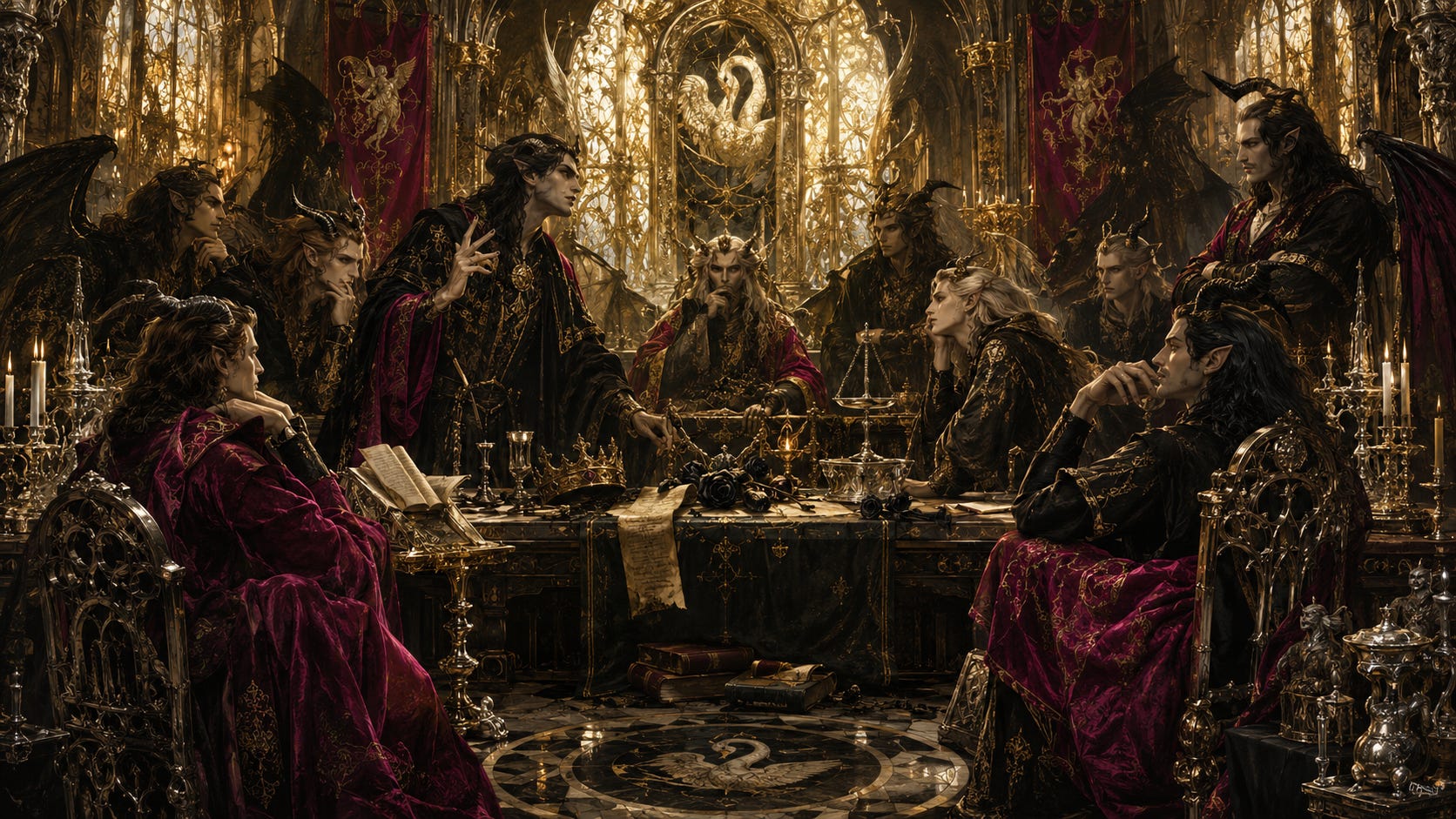
This is why the Swan Throne’s Eliadic account of orthodoxy and heresiology inside liberalism matters. Liberalism has boundaries. It has insiders, dissenters, heretics, schismatics, approved terms, and forbidden claims. The Christian who imagines himself entering neutral discourse is already standing inside a moral court whose verdict was prepared before the doors opened.
The council never ends because the bishops are all on panels.
VI. Apologetics must move from argument to order.
Debate should be abandoned as the central mode of apologetics.
This does not mean Christians should stop speaking. Speech matters. Doctrine matters. Argument matters in its proper place, especially inside communities already ordered toward truth. Catechesis requires clarity. Heresy requires correction. Children require instruction. Converts require patient teaching. Enemies sometimes require public rebuke.
But debate cannot remain the default Christian answer to civilizational decay.
The better apologetic is order.
Christianity must be shown through patterned communal life under sacred rule. A parish that forms families is an argument. A school that teaches children to sing, reason, pray, and honor their ancestors is an argument. A household that keeps feast days and fasts is an argument. A craftsman who makes beautiful things for worship is an argument. A father who governs his home with steadiness and mercy is an argument.
A graveyard kept with reverence is an argument.
A church that looks like heaven has touched stone is an argument.
A calendar that makes ordinary time bend around sacred time is an argument.
Liberalism wins when Christianity appears as opinion. Christianity regains force when it appears as order. The faith must once again become visible in space, durable in habit, and costly in loyalty. It must form men who cannot be bribed by comfort, women who cannot be flattered into rebellion, children who know they inherit a kingdom, and communities that outlast fashionable insanity by the simple method of refusing to dissolve.
The age of AI makes this urgent. Machine intelligence will multiply argument beyond human scale. There will be endless text, endless countertext, endless synthetic controversy. Debate will become a fog machine with a subscription tier.
The Christian answer is closer to walls against chaos than another public exchange under liberal house rules. The point is Benedictine in the old sense, rather than the internet’s usual tendency to turn every monastic insight into a productivity trick with incense.
Embodied Christian order will become more precious.
The future will belong to those who can still make reality.
VII. Christ the carpenter shows the true apologetic: build.
Jesus was a carpenter.
This fact is often sentimentalized until it becomes decorative, a little rustic trim on a doctrine too grand for modern taste. But the fact remains. The Word through whom all things were made entered the world in a household of craft. He touched timber. He learned measure, patience, pressure, grain, weight, and fit. He lived among tools before He carried the Cross.
This matters.
The Christian apologetic is not chiefly the clever defense of propositions before hostile judges. It is the public manifestation of a world redeemed by Christ. It is deed, form, rhythm, sacrifice, craft, fatherhood, worship, mercy, law, beauty, and courage made visible.
The carpenter does not argue a table into existence.
He builds it.
Christians must recover that instinct. Build homes where prayer is normal. Build churches that refuse ugliness. Build schools where children meet Homer, David, Augustine, Dante, Bach, and the saints without being processed through a moral paper shredder. Build businesses that honor skill over credentialed pretense. Build feasts. Build farms. Build choirs. Build guilds. Build households with thick walls against the age and open doors for the weary.
Build until the argument can be touched.
Eliade saw that sacred man consecrates space by founding a world. Christianity has the true center, the true axis, the true altar, the true King. The task is to live from that center with enough visible authority that debate becomes secondary, almost quaint, like bringing a pamphlet to a coronation.
This is the Christian pattern of sub-creation: receive the world from God, shape it under order, and hand it down with gratitude.
The task also requires refusing the liberal temptation to preserve decay because decay has inherited an official label. Christians must conserve the sacred rather than the rot. They must stop treating cultural defeat as a weather pattern and start treating it as a summons to craft, rule, and visible fidelity.
The liberal order wants Christians permanently explaining themselves.
Christ calls them to make disciples, baptize nations, teach obedience, forgive sins, feed the hungry, raise children, bury the dead, and worship the living God.
The answer to the ritual of debate is the rite of Christian life.
The age does not need Christians who can win arguments inside liberal temples.
It needs Christians who can build Christendom in miniature, then in stone, then in law, then in time.
I have not read anything from you. But this is is brilliant and spot on. I will save it to read it again and practice it. Thank you for sharing.